✦ Smarter Birding

Go birding when conditions are actually right

ChirpScout combines real-time weather, long-term habitat intelligence from years of eBird and citizen-science data, and a five-year NC field study to score hotspots — before you leave the house.
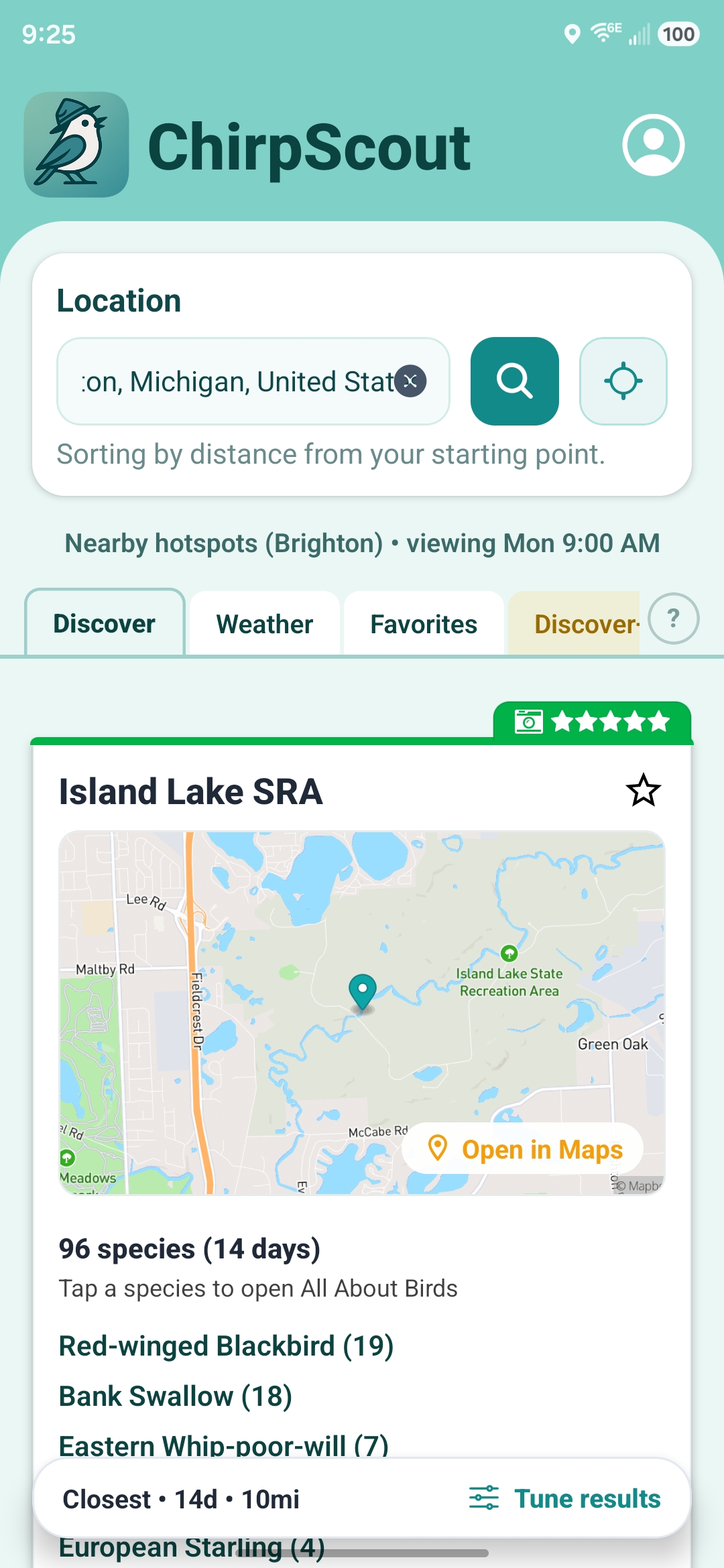
ChirpScout Discover screen showing hotspot suitability scores

About ChirpScout

Built on real birding data — not guesswork

ChirpScout started with a simple question: why do some birding trips produce ten times as many species as others, even at the same location? The answer turned out to be a precise combination of weather timing, habitat structure, and seasonal migration patterns — not luck.

We conducted a five-year study across 378 North Carolina hotspots to quantify exactly what separates a great morning from a forgettable one. That research validates the weightings behind every score — applied on top of years of accumulated eBird, OWS, and NOAA data.

146K+ Birding observations
378 Hotspots studied
5 yrs Of NC field data
🌤
Weather Timing
Post-frontal mornings produce 33% more birds per checklist on average
+33%
🌿
Habitat Quality
Location quality explains 2.9–3.7× variance within a single county
3.7×
🌡
Temperature Curve
Cool fall mornings outperform warm ones by 2.3× for bird activity
2.3×

Who We Are

A research project at the intersection of citizen science, meteorology, and the outdoors

ChirpScout is an active research project working toward formation as a 501(c)(3) conservation technology non-profit. Our mission is to put the tools of environmental data science — geospatial analytics, meteorological modeling, and citizen science infrastructure — in service of people who love the outdoors, and in service of the habitats that make that possible.

We believe that helping someone have an exceptional morning at a local nature preserve is conservation work. Better data leads to better experiences. Better experiences build deeper attachment. Deeper attachment protects land.

Geospatial analytics
Forest cover, water proximity, elevation, and terrain relief — structural attributes that explain why some locations consistently outperform others.
Meteorological modeling
Weather signals calibrated against observed bird activity — not human comfort proxies, but conditions that actually drive bird behavior.
Citizen science
Built on eBird, the world's largest biodiversity database. Every recommendation draws on observations contributed by birders across decades and continents.
Read the full story →

How It Works

Three signals. One score. Better mornings.

01
Built on years of real data
Habitat scores draw on years of accumulated eBird and citizen-science observations across thousands of hotspots. A five-year NC field study — 146,185 checklists, 378 sites — validated which factors actually predict a great morning and how much each one matters.
02
Weather updated every hour
Hourly NOAA weather — wind, temperature, frontal passage, precipitation — is layered over habitat quality alongside the past two weeks of eBird activity at each location. You get current conditions at a specific hotspot, not a regional average.
03
One score. Clear answer.
Habitat quality × current conditions = a single suitability score for every nearby hotspot. Know whether it's worth the drive before you leave the house. No spreadsheets, no weather app math, no uncertainty.

Try It Now

What's the best hotspot near you right now?

Enter your zip code and we'll find the top-ranked birding hotspot near you — scored live using ChirpScout's habitat model and current weather conditions.

Want scores for every hotspot near you, updated hourly? Get early access →

Migration Study 2021–2025

A five-year field study. Published for anyone to explore.

We cross-referenced 146,185 eBird checklists with NOAA weather records across three ecologically distinct NC regions to measure exactly how much weather, habitat, and timing shift bird activity. The study validates the model weightings — it doesn't replace the broader data foundation of years of eBird and OWS records the scores are built on. The full study is publicly available.

+33%
Birds/checklist, post-frontal mornings
3.7×
Hotspot quality variance within a county
2.3×
Cool vs. warm morning activity, fall
−16%
Outcome variance under excellent conditions
chirpscout.com/migration · Live
Triangle hotspots studied ~195 hotspots
Asheville hotspots studied ~183 hotspots
Coastal NC hotspots studied ~130 hotspots
Total species detected 345 species
Coastal NC species diversity 307 species
Study site-days ~2,745 days
Post-frontal days confirmed 121 days
Wind threshold corrected 10 → 15 mph

Get the App

Available now on iOS. Android coming soon.

iOS
Open Beta

ChirpScout is available right now on iPhone via TestFlight — Apple's official beta platform. No invite needed, no waitlist. Download and start scoring hotspots in under a minute.

Download on TestFlight
Android
Closed Beta

Android is in active development. We're onboarding a small group of testers now. Send us a note through the contact form and we'll get you in.

Request Android Access →

Get in Touch

Questions, feedback, or research inquiries

ChirpScout is in active beta. We'd love to hear from birders, researchers, and conservation organizations interested in what we're building.

For Android beta access, press, or research partnership inquiries, select the appropriate reason in the form and we'll route your message accordingly.